

Why Commercial Doors Fail in the Winter (It's Usually Not the Lock)
How Fall Maintenance Can Prevent Getting Locked Out
Every January we get the same call, usually before 7 a.m., usually from someone standing outside in the dark: the key won’t work.
And most of the time, the key is fine. The lock is fine too.
This is the part that surprises people, so we’ll put it up front: in commercial buildings in this climate, the majority of cold-weather “lock failures” are not caused by the lock cylinder. They’re caused by the door, the frame, the closer, the strike, and moisture. Lubrication matters — we’ll cover it properly, because most advice on the subject is wrong in specific and expensive ways — but lubricating a cylinder does nothing for a door that has shifted a quarter inch in its frame since September.
If you manage buildings in the Fox Valley, this is the article we’d want you to read in October rather than January.
Why Northeast Wisconsin is Hard on Door Hardware
It isn’t just the cold. It’s the swing.
January in Appleton averages a high of about 22°F and a low near 11°F, with snow falling on roughly 14 days of the month and relative humidity around 88%. Across the year, temperatures typically range from about 12°F to 81°F.
But averages hide the thing that actually breaks hardware. In January 2025, Wisconsin bottomed out at −32°F on the 20th during the state’s first Extreme Cold Warning under the revised NWS system — and then, ten days later, several locations set record highs, with La Crosse hitting 58°F and breaking an all-time January record.
A 90-degree swing in ten days is what a door and frame actually experience. Metal contracts and expands. Concrete and masonry move. Frost pushes on footings and slabs. Moisture condenses inside cylinders and freezes overnight. Gaskets stiffen. Hydraulic fluid thickens.
A door that latched perfectly in September is a genuinely different assembly in January. That’s not a maintenance failure — it’s physics. The maintenance failure is not accounting for it.
Diagnose Before You Lubricate the Lock
Reaching for a can before you know the symptom is how people make things worse. Here’s what to know:
| Symptom | Most Likely Cause | Lubricant will help? |
|---|---|---|
| Key won't insert, or stops partway | Debris or ice in the keyway; gummed old lubricant; worn key | Sometimes, after cleaning |
|
Key inserts fully but won't turn |
Pins binding (dry or gummed); or the bolt is under load from a misaligned door | Only if it's the pins |
| Key turns but the door won't open | Latch or bolt binding against the strike; door sag; frame movement | No — this is alignment |
| Door won't latch, blows open in wind | Closer too slow for the cold; weatherstrip drag; misaligned strike | No, closer or alignment |
| Door slams hard | Closer running fast — often a summer setting never changed back | No, closer adjustment |
| Works midday, fails first thing in the morning | Overnight condensation freezing in the cylinder or at the threshold | Partially, needs moisture control |
| Exit device won't depress | Ice at the threshold or a bound latch | No, and this is a life-safety issue |
The tell that separates “lock problem” from “door problem” is worth learning: look at the strike plate. If you see bright scrape marks, wear patterns, or a groove where the latch has been dragging against the edge of the strike instead of entering it cleanly, your door has moved. No amount of lubricant fixes that. It needs the strike adjusted, the hinges checked, or the door realigned.
Second tell: if the key operates smoothly with the door standing open, but binds when the door is closed, the cylinder is fine. The bolt is loaded.
If Your Entrance is an Aluminum Storefront Door, Read This Twice
The most common commercial entrance in the Fox Valley is a narrow-stile aluminum door with glass — and it behaves differently in winter than a hollow metal door. Aluminum expands and contracts roughly twice as much as steel for the same temperature change, and these doors don’t hang on hinges. They hang on pivots at the top and bottom corners, which wear and let the door drop.
The lock is different too. Most storefront doors use a hookbolt or deadlatch mounted in the door’s edge that has to land precisely in a strike cut into a thin aluminum frame. When the door drops a sixteenth of an inch on a worn pivot, or the frame shifts with the slab, the hook binds on the strike.
The symptom is a key that turns hard or won’t turn at all — and the instinct is to lubricate the cylinder. The cylinder is fine. Try the key with the door standing open; if it turns easily, the fix is pivot and strike adjustment, not a can of anything.
Lubricants: What to Use & What to Never Use
Don't use WD-40 (the Original Multi-Use Formula)
This is the single most common and most damaging thing done to locks, and the reason it persists is that it appears to work.
WD-40 is a water-displacement spray designed to loosen rust and temporarily displace moisture. It can free a stuck lock in an emergency, but it leaves behind a residue that attracts grime and dries into a sticky film. The solvent component — a petroleum distillate — strips away the factory lubricant the pins and springs depend on.
The failure pattern is delayed, which is why nobody connects cause and effect. You spray it, the lock feels instantly smoother, and you assume the problem is solved. Inside the cylinder, dust sticks to the oil, the oil thickens over time, and the pins begin sticking instead of sliding. Locks that “suddenly stop working” often fail months after the wrong lubricant went in.
And specific to our climate: WD-40 isn’t formulated for extreme cold, and the residue can stiffen or freeze in sub-zero conditions.
If WD-40 has already been used, the cylinder generally needs a proper cleaning to flush the residue before the correct lubricant is applied. Adding good lubricant on top of bad residue doesn’t fix it.
Household, 3-in-1, or Motor Oil; Cooking Spray, or Any Other Grease
Thick lubricants should never go inside a lock; once grease is in a cylinder, there’s usually no DIY remedy and the lock needs disassembly or replacement.
Wet lubricants trap dust, dirt, and microscopic metal particles worn off the key, creating a sludge that gums up pins and springs and accelerates wear.
DO Use a Dry-Film Lubricant
A PTFE (Teflon) dry lubricant such as Tri-Flow goes on wet so it carries into the cylinder, then dries to a slick film that doesn’t hold dust — which is the whole point. It lubricates without turning into the sticky paste that traps grime. A short application once or twice a year keeps deadbolts, knobs, padlocks, and vehicle locks turning cleanly.
PTFE and dry-film silicone are particularly well suited to exterior and high-moisture openings, drying clean and leaving a water-repellent film that resists dust and corrosion. In a climate with 88% winter humidity, that matters.
Graphite: The Nuanced Answer
Powdered graphite is the legacy lock lubricant, and it genuinely works — with caveats that matter a great deal here.
On a new or freshly cleaned lock, graphite is fine. The problem is buildup: it accumulates and can jam the cylinder over time. It’s dry, non-sticky, doesn’t attract dust, and performs well in cold — but it’s messy, it can stain, and it’s a poor choice for locks exposed to rain, because graphite plus moisture makes a paste.
Our working guidance for this region: graphite is acceptable for clean interior cylinders, and a poor choice for exterior doors. And never put graphite into a cylinder that already has oil in it — that combination is exactly the abrasive paste you’re trying to avoid.
One More Rule: Don't Mix!
Different lubricant chemistries don’t cooperate. If you’re switching products, or you’ve inherited a building where nobody knows what’s been sprayed into what, clean first and then lubricate. Flush the keyway with an appropriate cleaner, work the key in and out to carry it through, and let it dry before applying lubricant.
Different Components, Different Products
A lock cylinder, a hinge, an exit device, and a door closer are four different machines.
- Cylinders: dry-film PTFE
- Hinges: light machine oil on hinge pins and knuckles, applied after cleaning off any rust or corrosion — winter temperature cycling and moisture displace lubricant.
- Exit devices and panic hardware: follow the manufacturer's instructions specifically. Some assemblies specify particular products and prohibit others.
- Door closers: these are sealed hydraulic units. Do not attempt to lubricate or refill a closer. They're adjusted, not lubricated, and a leaking one is replaced.
- Electric strikes, mag locks, and electrified hardware: don't spray lubricant into solenoids or onto mag lock faces. Contamination on a mag lock's mating surface reduces holding force.
A note on fire-rated openings: if a door is fire-rated, it’s a life-safety assembly governed by NFPA 80, which requires annual inspection and documentation, and prohibits field modifications to the door, frame, or hardware.
Don’t drill it, don’t shim the strike creatively, and don’t do anything that would prevent the door from closing and positively latching on its own. If a fire door isn’t latching, that’s a code deficiency, not a maintenance annoyance — fix it properly.
How to Actually Lubricate a Cylinder
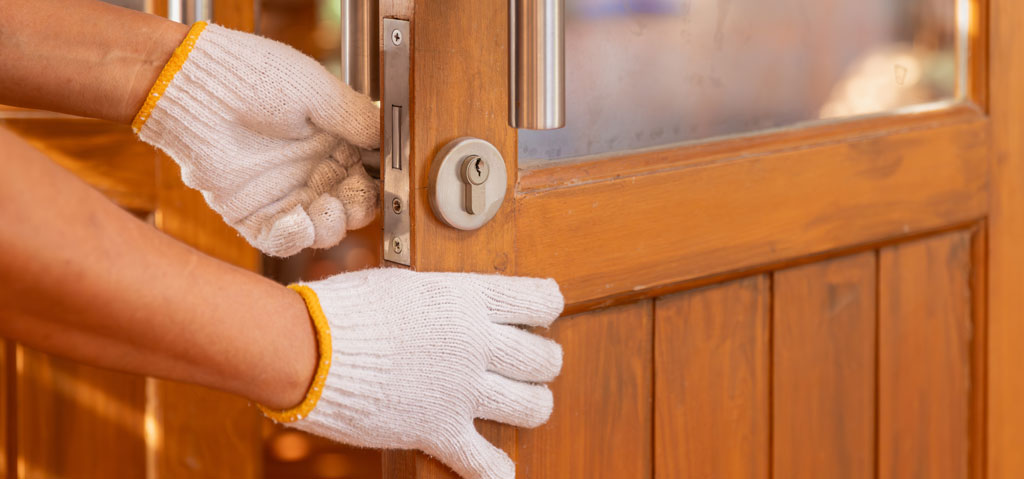
1.) Do it in the fall, before the freeze. September or October in the Fox Valley. Lubricating during a cold snap is damage control, not maintenance.
2.) Clean first if the lock is already gummed. Don’t layer new product over old residue.
3.) Use the straw and apply a short burst into the keyway. Less is more — a brief application is the correct dose.
4.) Work the key in and out ten to fifteen times to distribute lubricant through the pin chambers.
5.) Wipe the key and the face of the cylinder. Then repeat once or twice a year.
6.) Protect the door face. Overspray on painted, powder-coated, or anodized surfaces is unattractive and sometimes permanent. Shield it.
7.) Log it. Date, door, product used. In a year, when a lock is misbehaving, knowing what went into it is genuinely useful.
One honest caveat: if a lock is still stiff after cleaning and lubricating, the key is worn, or the cylinder is failing, and more lubricant only masks it. Worn keys are extremely common in commercial buildings, where a key might be a fifth-generation copy of a copy.
Door Closers: The Most-Neglected Winter Adjustment
If we could get every facility manager in northeast Wisconsin to do one thing each fall, it would be this.
A door closer controls speed by pushing hydraulic fluid through adjustable valves, and that fluid is temperature-sensitive. In cold weather it thickens and moves more slowly, so the door slows down; in heat it thins, and the door speeds up. A closer perfectly tuned at 68°F in September will drag in January. In the cold, the door drags and sometimes fails to latch at all.
A door that doesn’t latch is an unlocked door. That’s the part that turns a comfort issue into a security issue — and on a fire-rated opening, into a code violation.
The practical fix is a seasonal tune: loosen the valves slightly in the fall so the door still latches when the fluid is thick, then tighten them in the spring so it doesn’t slam when the fluid thins.
Budget roughly 15 minutes per door in a facility with significant temperature swings, and keep a maintenance log recording the as-left valve settings and the ambient temperature at the time — so that six months later you have a starting point rather than a blank slate.
Two important limits on DIY adjustment:
1. Opening Force is Regulated
Accessibility requirements cap the force needed to open interior doors, and fire doors must close and positively latch on their own.
“Just make it easier to open” is not always a legal option — the two requirements have to be satisfied together, which sometimes means a different closer rather than a different setting.
2. Adjustment Has a Ceiling
Seasonal valve adjustment works well for moderate cold-weather slowdown, but extreme cold can overwhelm what adjustment can compensate for even at maximum valve opening.
If a closer can’t achieve adequate latching speed in cold conditions despite adjustment, it likely needs replacement with a model rated for the temperature range. Closers built for cold climates use hydraulic fluids formulated to hold viscosity across roughly −40°F to 150°F.
And know when adjustment isn’t the answer at all: check every exterior closer for oil seepage on the body, arm, and surrounding surfaces — visible oil means seal failure and the closer needs replacing. A closer body can’t be refilled in the field. If the fluid has leaked out, you’re running a spring with no damping, and it must be replaced.
Finally, before you touch the valves, rule out mechanical causes: weatherstripping too aggressive for the closer to overcome, a latch not engaging the strike, backcheck set too firmly, or the door hitting a floor stop or carpet before the latch engages.
Automatic Operators Have the Same Problem, With Higher Stakes
If any of your doors has a push-button or wave-to-open operator, it’s fighting the same cold hydraulic fluid, stiff weatherstripping, and wind load that a closer is — and it’s one of the most common winter service calls we get.
The symptoms are a door that opens partway and stalls, opens and won’t close fully, or throws a fault and stops responding. Push plates and wireless transmitters also run on batteries, which lose capacity in cold; a dead push plate looks exactly like a dead operator.
Two cautions. First, don’t simply turn up the force. Low-energy operators are governed by ANSI/BHMA A156.19, which limits opening speed and force for safety, and an operator cranked past those limits is a liability, not a fix. Second, a door that opens on command but doesn’t latch behind people is worse than one that’s stuck closed — it’s an unlocked door that also dumps heat.
Watch a full open-and-close cycle on every operator each fall, confirm it latches, and have your integrator adjust it within the standard if it doesn’t.
Commercial Lock Case Study
Example: “Last winter we stopped out at a local commercial office building to help fix an issue with [X].”
Fall Commercial Door Checklist
Work through this in September or October, opening by opening.
1. Cylinder & Key
- Clean and lubricate with dry-film PTFE
- Replace worn keys and cut new ones to code rather than duplicating a worn original
- Verify every key you expect to work actually works, including after-hours and emergency keys.
- Confirm the key box / Knox Box contents are current.
2. Door & Frame
- Check latch alignment against the strike; look for scrape marks.
- Check hinges for sag, wear, and loose screws.
- Confirm the door closes and latches fully on its own, every time, without assistance.
3. Closer
- Seasonal sweep and latch speed adjustment
- Inspect for oil seepage.
- Verify the door still latches at the new setting — actually watch it close, several times.
4. Weather Protection
- Inspect weatherstripping and door sweeps for compression, hardening, and tears — over-aggressive gasketing adds drag the closer must overcome
- Clear threshold drainage weeps
- Address grading or drainage that directs water toward entrances
- Use only de-icing products approved for the threshold material; avoid rock salt on aluminum thresholds, which causes corrosion.
5. Electrified & Access-Controlled Openings
- Verify readers and keypads are rated for the temperatures they'll see
- Check enclosures for condensation and water intrusion.
- Replace batteries in wireless and standalone electronic locks before winter. Battery capacity drops substantially in cold, and a battery that reads fine at 70°F can fail at 5°F. This is one of the most common winter service calls we see on electronic hardware.
- Confirm your mechanical override plan and that the override keys exist and work.
6. Life Safety
- Verify every exit device operates freely.
- Check that ice cannot accumulate where it would block egress.
- Confirm fire doors close and positively latch.
- Confirm NFPA 80 annual inspection documentation is current.
If a Lock is Already Frozen
Field guidance, in order of preference:
Do:
- Use a different entrance if one is available, and deal with the frozen lock in daylight.
- Apply a commercial lock de-icer (typically alcohol-based) into the keyway.
- Warm the cylinder gently and indirectly — a hand warmer or a gloved hand held against it for a minute or two.
- Once it opens, dry it out and apply dry-film lubricant, or it will freeze again tomorrow.
Don't:
- Force the key. A key snapped off in a frozen cylinder converts a ten-minute problem into a service call and possibly a new cylinder.
- Heat the key with a lighter or torch. It's a persistent piece of internet advice and a bad one — it damages the key, can deform brass components and ruin finishes, and burns fingers.
- Pour hot water on the lock or threshold. It runs into places you can't see, refreezes, and makes tomorrow considerably worse.
- Use WD-40 as a de-icer. It displaces water, which is why the advice exists, but you're trading tonight's problem for a gummed cylinder in March.
The recurring theme: a lock that freezes is telling you moisture is getting in. Fix the moisture — the weatherstripping, the drainage, the gaskets — not just tonight’s ice.
What a Professional Fall Service Visit Should Cover
- Cleaning and lubrication of every cylinder with the correct product
- Seasonal closer adjustment on all exterior and vestibule doors, with settings documented
- Latch and strike alignment verification and correction.
- Hinge inspection and lubrication
- Weatherstripping, sweep, and threshold inspection
- Exit device operation and life-safety verification
- Battery replacement on electronic and wireless hardware
- Key verification, including emergency and override keys
- A written report of what was found, what was corrected, and what needs attention. This is the deliverable that distinguishes maintenance from a visit.
Frequently Asked Questions (FAQs)
Below are some of the most frequently asked questions we get about commercial lock failures and lubrication:
What is the best lubricant for door locks?
A dry-film PTFE (Teflon) lubricant. It carries into the cylinder wet and dries to a slick film that doesn't attract dust. Apply once or twice a year.
Can I use WD-40 on a lock?
Not as a lubricant. It's a solvent and water displacer that strips the factory lubricant, leaves a residue that attracts grit, and can stiffen in cold. It can free a stuck lock in an emergency, but the cylinder should be cleaned and properly lubricated afterward.
Is graphite good for locks?
It works on clean, dry, interior cylinders. It's a poor choice for exterior doors in a wet, freezing climate because graphite and moisture form a paste, and it builds up over years. Never combine it with oil.
Why does my door stop latching in winter?
Almost always the door closer. Cold thickens the hydraulic fluid; the door closes more slowly, and it doesn't build enough momentum to latch. A seasonal valve adjustment usually fixes it; if it doesn't, the closer may be undersized, leaking, or unrated for the temperature.
Why does my key work in the afternoon but not in the morning?
Overnight condensation freezing inside the cylinder. The underlying issue is moisture intrusion — weatherstripping, drainage, or an unprotected exterior cylinder.
When should I schedule fall lock maintenance in Wisconsin?
September or October, before sustained freezing. Doing it during a cold snap is triage.
My key is getting harder to turn. Is the lock failing?
Often it's the key, not the lock — worn keys are extremely common in commercial buildings where keys have been duplicated repeatedly. Cutting a fresh key to code frequently resolves it.
Commercial Locksmith Solutions You Can Trust!
Lappen Security Products provides business owners in Appleton and the Fox Cities area with reliable locksmith and lubrication services. If you need a commercial locksmith service, please don’t hesitate to reach out! We are looking forward to working with you.
- Hours: Mon - Fri: 8:30 am - 4:30 pm
About the Author
Bringing [X] years of expertise as a Certified Registered Locksmith, Matthew Bent designs and services advanced access control and key systems for Fox Valley businesses, healthcare facilities, and local municipalities.
As an authorized Medeco dealer, Lappen Security Products delivers trusted security solutions to Appleton, Neenah, Little Chute, Green Bay, and nearby areas.